
- Index
- Brand
- Metal Purity
- Occasion
- Ring Size
- Shape
- Abstract (6)
- As Seen As Picture (2)
- As Seen In Picture (4)
- Asymmetrical (12)
- Big Round Pendent (3)
- Big Spiral Pendent (2)
- Butterfly (3)
- Cross (7)
- Crown (5)
- Cylindrical (2)
- Flower (13)
- Flowers Pendent (4)
- Heart (27)
- Oval (44)
- Rectangle (16)
- Round (61)
- Same As Image (10)
- Square (10)
- Star (2)
- Teardrop (4)
- ... (4000)
- Type
Vtg 1930s Art Deco Geometric Cut Glass Paste Sterling Silver Link Bracelet
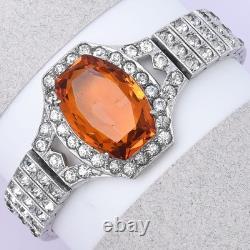
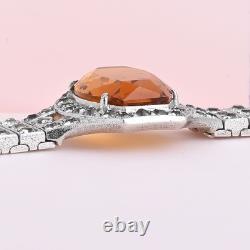
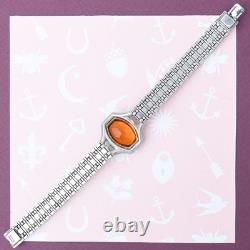
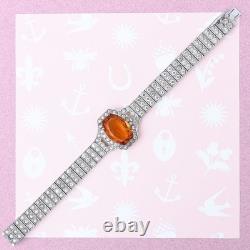
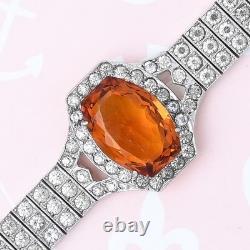


This golden-hued 1930s bracelet features a timeless design with an eye-catching geometric cut glass at the focal point crafted to emulate Topaz within a sterling silver setting. An Art Deco classic, the inset paste along the links, wrap seamless along your wrist for endless shimmer and embodies the craftsmanship that the era is known for. Bright patina with minimal surface wear to the setting. Fresh sheen, crisp facets, and no chipping on the glass. On Glass Made to Emulate Gemstones. Glass has long been used by jewelers to simulate natural gemstones. For instance, during the Georgian era, black dot paste is a term that refers to a style of glass that was made to simulate the sparkle of natural diamonds. But in the 1940s, the use of glass to simulate gemstones ramped up more than ever before.
World War II constrained both fine materials and pocketbooks, so more and more designers (including high-end designers) focused on glass to re-create the distinctive properties of different gems. High-end designers thus began making costume glass jewelry - but with the same attention to detail, high craftsmanship, and design skill that was applied to fine jewelry.
Art Deco is one of the first truly international styles, that influenced the design of buildings, furniture, fashion and of course, jewelry. The movement was given a name from the international exposition of Arts Decoratifs et Industriels Modernes, that was held in Paris in 1925 and largely dedicated to the jewelry arts. Born out of ideas of modernism and the Industrial Age, this manifested into designs that used Cubism's bold abstraction and rectilinear shapes and combined them with intricate patterning, bold color and symmetry.
High-end jewelry design houses like Cartier and Boucheron set the trends in gold and gemstones, which were then emulated by costume jewelry companies in glass or perhaps plastics, and brought to the masses. _gsrx_vers_1730 GS 9.9.4 (1730).